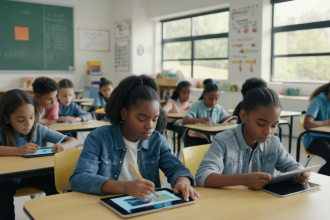

Science experiments for middle school kids can be both fun and educational. Discover 7 engaging experiments that will spark curiosity and help kids explore science.
Science Experiments for Middle School Kids
Ever thought of making science fun for middle school kids? It’s not just reading books or watching lectures. Imagine doing hands-on activities and learning together. This article shares 7 easy and fun science experiments for middle school kids. They teach important science concepts and keep kids curious and engaged.
1. The Magic of Baking Soda and Vinegar Reactions
The classic baking soda and vinegar reaction is a favorite. It’s easy, fun, and a bit explosive! This experiment shows a chemical reaction that makes carbon dioxide gas. This gas creates the fizzy bubbles when the two ingredients mix.
How to Do It:
- Mix baking soda with vinegar in a container.
- Watch as the mixture bubbles up and overflows.
What’s Happening: Vinegar and baking soda react to form carbon dioxide gas. This gas makes the bubbles that fizz up.
Why It’s Awesome:
- It’s a hands-on way to understand chemical reactions.
- It’s safe, easy, and budget-friendly for any science project.
2. The Power of the Invisible Ink
Want to write secret messages like a spy? Use lemon juice as invisible ink. It shows how acids and heat can work together.
How to Do It:
- Squeeze lemon juice into a small bowl.
- Use a cotton swab or brush to write a message on a piece of white paper.
- Let the paper dry, then use a heat source (like a light bulb) to reveal the message.
What’s Happening: Lemon juice has citric acid that stays invisible on paper. When heated, the acid oxidizes and turns brown, revealing the message.
Why It’s Awesome:
- Kids love secret codes.
- It introduces the concept of chemical reactions and oxidation.
3. Create Your Own Lava Lamp
Ever wondered how lava lamps work? Now you can make your own with simple ingredients. This experiment teaches about liquids and density.
How to Do It:
- Fill a clear bottle halfway with vegetable oil.
- Add water to fill the rest of the bottle, leaving a little space at the top.
- Add food coloring to the mixture.
- Drop a fizzy tablet (like Alka-Seltzer) into the bottle and watch the magic happen!
What’s Happening: Oil and water don’t mix because of their different densities. The Alka-Seltzer tablet releases carbon dioxide gas. This creates bubbles that rise and fall, like in a lava lamp.
Why It’s Awesome:
- Kids get to experiment with the properties of liquids.
- It’s a fun way to learn about density and chemical reactions.
4. Make a Rainbow with a Glass of Water
A great way to show the science of light is with the rainbow in a glass of water experiment. It’s simple but amazing. It shows the power of light refraction.
How to Do It:
- Fill a glass with water and place it on a sheet of white paper.
- Position the glass at an angle in sunlight and adjust until a rainbow appears on the paper.
What’s Happening: Light bends as it passes through the water, splitting into different colors (red, orange, yellow, green, blue, indigo, violet) due to the process called refraction.
Why It’s Awesome:
- Kids love seeing rainbows, and this teaches the concept of light and refraction in a fun, visual way.
5. The Balloon-Powered Car
Who doesn’t love cars? With this experiment, you can build a simple car powered by a balloon. It introduces the basics of air pressure and thrust.
How to Do It:
- Attach a balloon to the back of a toy car or a homemade car using a plastic straw.
- Inflate the balloon, and let go to watch the car zoom across the room.
What’s Happening: The air in the balloon pushes out through the straw, creating a thrust that propels the car forward.
Why It’s Awesome:
- It’s a hands-on way to learn about air pressure, force, and motion.
- Kids get to build something they can race!
6. The Egg Drop Challenge
This experiment tests your ability to protect an egg from breaking when dropped from a height. It’s a great way to teach kids about force and impact.
How to Do It:
- Give kids materials like straws, cotton balls, rubber bands, or bubble wrap.
- Challenge them to create a structure to protect an egg from a drop.
What’s Happening: The structure helps to absorb the impact and distribute the force, reducing the risk of the egg cracking.
Why It’s Awesome:
- It promotes creativity and problem-solving.
- Kids learn how engineers design things to absorb shock.
7. Make Your Own Volcano
Building a volcano and making it erupt is a timeless science project. This experiment helps kids understand volcanic eruptions and the science behind them.
How to Do It:
- Build a volcano shape using clay or playdough around a bottle.
- Fill the bottle with baking soda, dish soap, and food coloring.
- Add vinegar to start the eruption!
What’s Happening: The reaction between baking soda and vinegar creates carbon dioxide gas. This gas makes the mixture bubble and overflow, mimicking a volcanic eruption.
Why It’s Awesome:
- It teaches about geology, chemical reactions, and volcanic eruptions in an exciting way.
Conclusion
Science experiments for middle school kids are easy and fun. You can make fizzy reactions with vinegar and baking soda. Or, you can create volcanoes and lava lamps.
These activities help kids love science. They are great for school or just for fun at home. Learning science becomes exciting and memorable!
FAQs
1. What is the best science experiment for middle school kids?
The best experiments are fun and teach something new. Try the baking soda and vinegar reaction or make a volcano.
2. Are these experiments safe for kids?
Yes, they are safe with adult supervision. Always follow the safety rules.
3. Can I do these experiments at home?
Yes! You can use things you have at home. It’s easy to set them up.
4. How can I make science more fun for kids?
Make it hands-on with activities and projects. The more fun it is, the better kids will learn.
5. How long do these experiments take?
Most take less than 30 minutes. They’re perfect for a fun afternoon.