
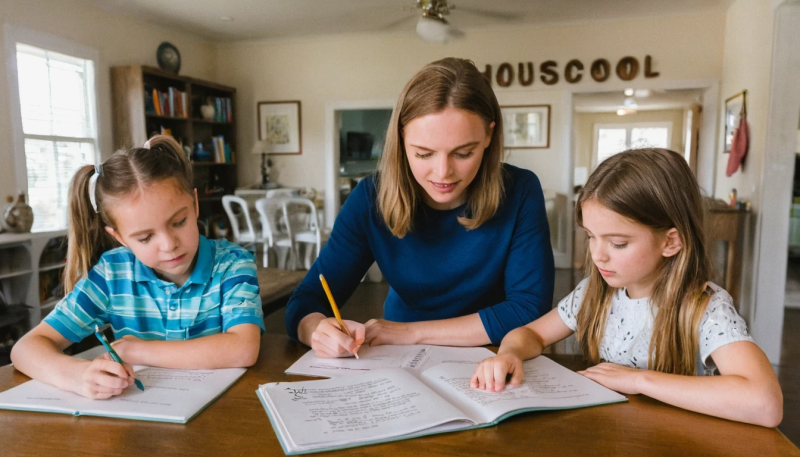
How to homeschool third grade curriculum effectively with fun strategies, daily structure, and smart tips for stress-free success at home.
How to Homeschool Third Grade Curriculum
Ever wonder if you’re really qualified to teach your third grader at home?
Spoiler alert: You are. You don’t need a teaching degree or a perfect classroom. What you need is a plan, some tools, and lots of love. Third grade is fun because kids are curious and ready to learn big things. Let’s learn how to do it together, step by step.
1. Understand What Third Grade Really Looks Like
By third grade, kids start to read more than just simple books. They dive into reading to learn. They learn to write paragraphs, do math problems, and read chapter books. They also learn about the world, science, and history.
It’s a year where learning gets more grown-up but stays fun.
2. Know Your State’s Homeschooling Laws
Every U.S. state has its own homeschool rules. Some ask for tests, others for portfolios or declarations.
✅ Quick Tip: Check HSLDA.org to find your local homeschooling rules.
You’ll want to look up:
- Attendance requirements
- Recordkeeping rules
- Curriculum approval (if required)
3. Choose the Right Curriculum for Your Family
Not every curriculum fits every kid or parent. Some are strict, others flexible. Think about what works best for your family.
| Style | Best For | Popular Examples |
|---|---|---|
| Classical | Strong readers, structured families | Memoria Press |
| Charlotte Mason | Gentle, literature-based learning | Simply Charlotte Mason |
| Unit Studies | Themed, multi-subject approach | Gather Round |
| Unschooling | Interest-led, relaxed approach | Life of Fred, DK Books |
| Online Programs | Tech-friendly homes | Time4Learning, Khan Academy |
Want to mix and match? Totally okay. Many families do what’s called “eclectic homeschooling.”
4. Plan a Flexible Daily Schedule
Every homeschool day is different. But having a routine helps everyone stay organized. Here’s a sample third-grade routine:
| Time | Activity |
|---|---|
| 8:30 AM | Morning routine + breakfast |
| 9:00 AM | Math |
| 9:45 AM | Language Arts (reading, grammar, writing) |
| 10:30 AM | Break/snack |
| 11:00 AM | Science or Social Studies |
| 12:00 PM | Lunch + free time |
| 1:00 PM | Art, music, PE, or fun project |
| 2:00 PM | Independent reading or play |
5. Cover the Core Subjects (The Must-Haves)
Here’s what your third grader should be learning in each major subject:
- Math: Multiplication, division, word problems, fractions, telling time, measurement.
- Reading: Comprehension, fluency, vocabulary, main ideas, reading across genres.
- Writing: Paragraph structure, punctuation, grammar, short essays.
- Science: Life cycles, earth science, space, experiments.
- Social Studies: Communities, geography, U.S. history, basic economics.
💡Pro Tip: Use workbooks, online tools, games, and real-life activities to keep it fun and dynamic.
6. Add Enrichment Subjects (The Nice-to-Haves)
Want to nurture creativity and life skills? Add:
- Art (drawing, painting, sculpture)
- Music (instruments, rhythm, composers)
- PE (sports, yoga, dance)
- Coding or foreign languages (basic Spanish, sign language, etc.)
🎨 These can be once or twice a week—and they make a big impact.
7. Incorporate Hands-On Learning
Third graders thrive when they do more than just listen.
Try these fun add-ons:
- Science experiments with baking soda, magnets, or plant growth
- Math games like card math or sidewalk chalk multiplication
- Geography puzzles and scavenger hunts
- Cooking together to teach measurements and following steps
Learning sticks better when it’s hands-on and full of curiosity.
8. Read Together—A Lot
Read aloud every day. It builds vocabulary, imagination, and comprehension.
Favorite read-aloud picks for third grade:
- Charlotte’s Web by E.B. White
- The Boxcar Children series
- Frindle by Andrew Clements
- Magic Tree House series
- Because of Winn-Dixie by Kate DiCamillo
📚 Reading isn’t just academic—it’s bonding time.
9. Use Educational Tech Wisely
Screen time doesn’t have to be a guilt trip. Try these smart tools:
- Khan Academy (free lessons for all subjects)
- Adventure Academy (learning through gaming)
- TypingClub (keyboard skills)
- Epic! (digital library for kids)
💻 Just aim to balance tech with pencil-paper and physical play.
10. Join a Homeschool Group or Co-op
You don’t have to homeschool alone. Look for a local or online group for:
- Park days and field trips
- Curriculum swaps
- Group classes (science labs, art, PE)
- Encouragement and support for you!
🙌 A little community makes a big difference.
11. Assess Without the Stress
Not all tests are the same. Try:
- Oral narrations (“Tell me what you learned today.”)
- Weekly quizzes or games
- Journaling or lapbooks
- Portfolios with samples of work
✨ Many states don’t require formal testing—so you can evaluate growth in creative ways.
12. Create a Learning-Friendly Space
You don’t need a schoolroom—just a comfy spot that’s stocked and tidy.
- A desk or kitchen table
- A bookshelf for easy access
- Bins for supplies (crayons, pencils, scissors, etc.)
- A wall calendar or whiteboard for the day’s plan
🪴 Add plants, cozy rugs, or string lights for extra cheer!
13. Be Flexible and Give Yourself Grace
Here’s the truth: not every day will be perfect.
There will be tears, distractions, and skipped lessons. And that’s okay.
Homeschooling is not about doing everything right—it’s about building a life of learning that works for your family.
💬 “Education is not the filling of a pail, but the lighting of a fire.” —William Butler Yeats
Final Thoughts: You’ve Got This 💪
Homeschooling your third grader can be very rewarding. It’s about freedom, flexibility, and family connection. With the right tools, a bit of structure, and a whole lot of heart, you’ll not only cover the curriculum—you’ll spark a lifelong love of learning.
Take it one day at a time. Celebrate small wins. And remember: you’re doing better than you think.
🙋♀️ FAQs: Homeschooling Third Grade Curriculum
1. How many hours a day should I homeschool a third grader?
Usually 2–4 hours of focused learning is enough. The rest can be play, reading, and life learning.
2. Can I homeschool third grade without a set curriculum?
Yes! Many parents create their own using free resources, books, and online tools. Just make sure you’re covering core subjects.
3. What’s the best math curriculum for third graders at home?
Popular options include Singapore Math, Math-U-See, Beast Academy, and Teaching Textbooks.
4. How do I know my child is on track in third grade?
Use benchmarks from your state’s education department or refer to general third-grade standards online. Portfolios, quizzes, and reading levels help too.
5. How do I keep my third grader motivated at home?
Mix things up! Use hands-on activities, field trips, fun projects, rewards, and breaks to keep energy up and boredom down.